"A word on the spot is worth a cartload of recollections"
James Maggs, Southwold diarist 1797-1890

Tuesday, 30 November 2010

Virgin Ice


Here's Ines Papert climbing very steep ice on the Argentière glacier near Chamonix. Click on the link and watch full screen.

At one point she turns to the camera and you can see the intensity of the climb in her face. Give me axe hooks on a well-travelled route any time.

Thursday, 25 November 2010

Bimbo... and Fanny


Steve House and Marko Prezelj on Cayesh, Cordillera Blanca, Peru in 2005

If you're disappointed after reading that headline you may be looking at the wrong website...

Tuesday, 23 November 2010

The Suffolk coast


The Suffolk coast is my home. This thought struck me, incongruously, halfway along a 3 week walk through the Nepali Himalaya in 1997. On the other side of the planet, surrounded by huge mountains, I suddenly understood that if I have a home anywhere it's on the flat east Suffolk coast. This wasn't homesickness: I was having the time of my life. It was simply that I suddenly understood what Suffolk meant to me.

My mum and her side of the family came from Suffolk, and when my brother and sisters and I were growing up we spent lots of holidays on the coast there:

It's difficult to explain why this coastline has such a deep hold. Family connections and childhood memories are a part of it, but it's more than that. Somehow, over time, the place itself finds its own way into your soul.

Andrew Hurst, in his introduction to Carl White's book of photographs of this coastline, puts it well:
All counties are old; but Suffolk gives us age that resonates. To reach the coast one drives for some time, or takes a train with changes to branch lines, passing through rich wool country with its prosperous Cathedral churches and its Constable pasture and woodlands. At last, after the confines of car or carriage, there comes the long walk over pebbles that steal your stride and make you work - really work, if laden with kit or children - before you come over two or three heavy drops to stand on the shore and watch the big waves crashing in and hiss away in retreat over the stones. Here is the big sky, the vast sea, the buffeting wind and mile after mile of shore - bending, curving, rounding, but going on and on to the unseen horizon.

This is no sun-spot or fairground attraction; there are no warm blue sea or crystal wave - yet for many it is the best coast that we know in all seasons, the most compelling, arresting and awe-inspiring. It dwarfs us, soaks us and chills us, yet it is hard to turn away from[...] It tells us [...] that we are small, insignificant in the end, and only here on terms that are not our own, but part of something which we cannot really comprehend. And this sense acknowledged, realised so gently, can leave us happier, cleaner, reappraised and refreshed, in ways a hot-sand beach never could.

Monday, 22 November 2010

MMmmm ....


Nick and I drove up to Milton Keynes on Saturday, to the excellent Outdoor Shop. We bought snowshoes and other kit for our trip to Norway in February.

I had a rush of blood to the head and came back with a pair of Petzl Nomic axes. Of course, I'll climb at least 3 grades harder with these beauties... (ahem)

On Sunday Claire and I ran in the second annual Adnams 10K race in Southwold. Neither of us had been running much recently so weren't surprised at our slow finish times. I felt like I was running with a chest full of glue for the first 5K. After that my breathing eased but my legs wouldn't propel me any faster. We enjoyed it though.

Wednesday, 17 November 2010

Ice climbing is fun, really

Demonstrate or riot?


Here's a good analysis of the way in which demonstrations get hijacked.

Burma's lonely battle

Victoria Brittain writes about what makes the Burmese struggle different.

With China's economic support, the junta can afford to continue to ignore the rest of the international community. Whatever Obama and other world leaders say or do, they appear to have no traction with the Generals. It's interesting how powerless the US and UN have been.

I guess that the leaders of the regime feel much more threatened by Suu Kyi and her potential mobilisation of the Burmese people just now. How long will it be before they lock her up again?

Saturday, 13 November 2010

Freedom from fear

The Guardian reports today that
After seven years under house arrest and 15 of the last 21 incarcerated in some form by Burma's military regime, Aung San Suu Kyi today chose one last night of imprisonment so that she might walk truly free.
I doubt Aung San Suu Kyi is thinking in those terms at all.

I remember watching an interview of Suu Kyi filmed in her Rangoon home during one of the brief periods of her "liberty". I can't remember the details but her main point was a powerful one, about what it means to be free.

Even during her periods of house arrest, she said, she considered herself freer than many people in Burma - including those who had locked her up - because, for much of the time, she was free from fear.

In 1990 Suu Kyi gave a speech about what freedom means:
The quintessential revolution is that of the spirit [...] A revolution which aims merely at changing official policies and institutions with a view to an improvement in material conditions has little chance of genuine success. Without a revolution of the spirit, the forces which produced the iniquities of the old order would continue to be operative, posing a constant threat to the process of reform and regeneration. It is not enough merely to call for freedom, democracy and human rights. There has to be a united determination to persevere in the struggle, to make sacrifices in the name of enduring truths, to resist the corrupting influences of desire, ill will, ignorance and fear.

Saints, it has been said, are the sinners who go on trying. So free men are the oppressed who go on trying and who in the process make themselves fit to bear the responsibilities and to uphold the disciplines which will maintain a free society. Among the basic freedoms to which men aspire that their lives might be full and uncramped, freedom from fear stands out as both a means and an end. A people who would build a nation in which strong, democratic institutions are firmly established as a guarantee against state-induced power must first learn to liberate their own minds from apathy and fear.
As Aung San Suu Kyi leaves her house today and walks past the barbed wire into a city where (according to the Guardian) truckloads of police, dressed in riot gear and carrying assault rifles are stationed at key intersections, I doubt she will consider herself freer today than she was yesterday.

But while people like her exist there's still hope for Burma, and for the rest of us.


UPDATE at 12:00:

Suu Kyi has said a few words to the crowd outside her home and the first picture has been released.

She told the crowd: "we must work together to achieve our goals."
Monday, 8 November 2010

A beautiful tune

Its called Comptine d'un autre été - L'après-midi by Yann Tierson

Monday, 1 November 2010

Scottish Wings

Here's some inspiration for winter....

Sunday, 31 October 2010

Chalk!

Today Nick and I found the perfect venue for training for our February trip to Norway - the chalk sea cliffs on the south coast.

It's strange standing on a beach wearing crampons, though.


Saturday, 30 October 2010

Marie Marvingt, pt 2: France to Reydon in Suffolk by balloon, 1909

From Sports Illustrated, June 1961:

"The balloon held 900 cubic meters of hydrogen," she recalls. "It was called The Shooting Star and was the very last word in balloons. I'll never forget the trip as long as I live."

The Marvingt-Garnier balloon was virtually unnavigable. When The Shooting Star took off from Nancy [France] a rope connected to the ground tilted the gasbag and released pounds of precious hydrogen.The balloon sailed north from Nancy at an altitude of 1,000 feet over the German border, past the Krupp factories at Essen, past dazzled schoolchildren and peasants.

Because of the hydrogen lost at take-off, the balloon wouldn't rise higher than 1,200 feet. Near Essen the wind shifted suddenly and carried the craft northwest over Holland toward Amsterdam. "We were in the clouds most of the time," said Mademoiselle Marvingt, "but we thought after we reached Amsterdam that the most dangerous part of the trip was over. We knew we were losing altitude, but we knew that the Channel winds would sweep us over to England before nightfall."The wind did carry the balloon off the Continent and over the Channel. But the temperature dropped to below freezing, and the basket began to rise and fall dangerously close to the waves.

Before Marvingt and Gamier were five miles offshore they found themselves in the middle of a snowstorm.Marie threw out the last of the ballast, but still the balloon wouldn't rise more than 100 feet above the waves, often dipping until the basket actually was in the water.Night came, and the balloon continued bobbing into the choppy Channel. "My overcoat and wool stockings were no help," Marvingt said. "I was freezing. Besides that, we couldn't tell which way we were heading."

After battling the storm for five hours, the balloon suddenly lifted and rose through the clouds. Two miles distant Marie saw a light [of Southwold lighthouse] . It was the English coast. The balloon started to lose altitude and was headed toward the cliffs on the coast when an updraft caught it and lifted the pair over the top.

"It was still dark," Marie said. "We let out most of the hydrogen and put down in a pasture half a mile from the coast [in Reydon]. We barely had the energy to climb out of the basket. "

The Lowestoft Journal takes up the story:
The grounded aviator went looking for help and a man on a bike said she should have taken the ferry.

Another man later noted that he saw “a man with no hat on” gesticulating and talking rapidly in a foreign tongue – but shut his window and went back to bed.

Eventually four policemen were called to assist the adventurers. The next day, the balloon was packed up and, after purchasing several postcards, the pair left Southwold by train.

Marie Marvingt, pt 1

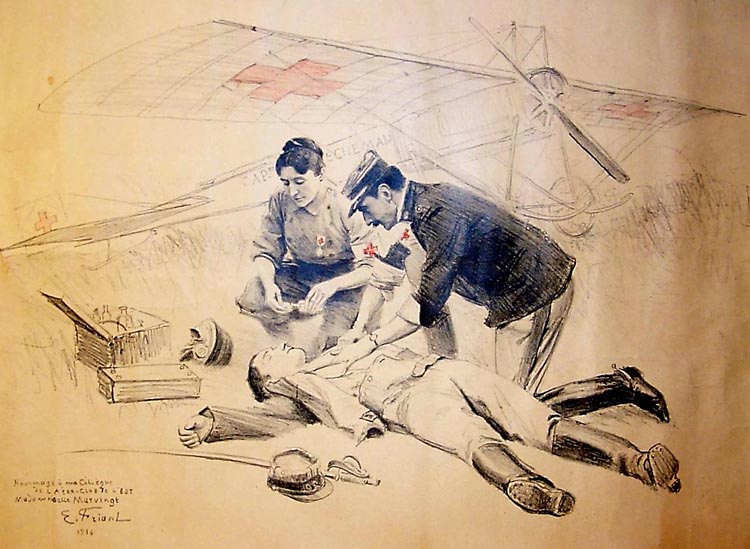
Mlle Marie Marvingt at the controls of her Deperdussin airplane in 1912

Marie Marvingt (1875-1963) was a pilot, balloonist, athlete, mountaineer, inventor, nurse, and much more.

She was born on February 20, 1875, at Aurillac, France. Her father, Felix, a postmaster, strongly encouraged Marie to pursue sports. By the age of five she reportedly could swim 4,000 meters. In 1890, when she was 15, she canoed more than 400 kilometers from her home in Nancy, France, to Koblenz, Germany. She also competed in water polo, speed skating, luge, bobsledding, boxing, martial arts, fencing, shooting, tennis, golf, hockey, football, mountaineering, and also studied at the local circus learning rope work, the trapeze, horseback riding, and juggling. In 1899 she earned her driver’s license. Marvingt was just getting started.

Between 1903 and 1910 she was one of the first women to climb most of the peaks in the French and Swiss Alps. In 1905 she swam the length of the Seine River through Paris, won an international military shooting competition in 1907 and became the only woman to be awarded the palms du Premier Tireur (First Gunner palms) by a French Minister of War. She dominated the winter sports seasons in France between 1908 and 1910, collecting more than 20 first place victories, including the women’s world bobsledding championship in 1910. And to get a good look at a volcanic eruption, she cycled from Nancy, France to Naples, Italy.
When she was refused admission to the 1908 Tour de France because, after all, it was a man’s sport, she successfully completed the course on her own, covering more than 4000 km and traversing 8 mountain passes, while averaging more than 150 km per day. Only 36 of 114 male riders completed the course during the official race that year.
In March of 1910 the French Academy of Sports (Académie des Sports) awarded her a Gold Medal for all sports, the only multi-sport medal the Academy has ever awarded.
Looking for new challenges, Marvingt soon turned her attention to aviation, first with hot air balloons and later with fixed-wing aircraft. Her first balloon ride was in 1901, she piloted a balloon in July 1907 and soloed as a balloon pilot in September 1909. In October of that year she became the first women to pilot a balloon across the North Sea and English Channel to England. The Aero Club of France issued her a balloon pilot’s license in June 1910 and in November she became the third women in the world – the second in France -- to be licensed to fly fixed-wing aircraft. She was the first woman to solo in monoplane (single wing) aircraft, generally believed to be more difficult to fly safely.
In her first 900 flights she reportedly never “broke wood”, or damaged an aircraft, which was a remarkable feat. Among those who learned to fly prior to WWI, 87 percent are said to have died in aircraft accidents.
[During World War I, she impersonated a man in order to fight on the front lines as an infantryman. After being discovered, she became the first women to fly bombing missions over Germany and was decorated with the Croix de Guerre for bombing a German airbase. She also pioneered the use of airplanes as air ambulances.]
In addition to the many things Marvingt did to earn a living, including journalism, poetry, and hosting conferences, she was also a trained surgical nurse with the Red Cross and various hospitals.
Marvingt never slowed down. When she was 80 she earned her helicopter pilots license, and later flew over her home town in a US fighter jet, reportedly breaking the sound barrier.
Marvingt cycled across France at the age of 86.

Marie Marvingt's Wiki entry is here.

Émile Friant's 1914 drawing of Marie Marvingt and her proposed air ambulance

Friday, 8 October 2010

Chilean miners

They're facing a media feeding frenzy when they come out, poor sods. Even the BBC are in on it. Everyone must see there's something wrong with this.

Sunday, 12 September 2010

Portland


The Isle of Portland isn't a pretty place. As Nick remarked during our trip there this weekend, it's character is dominated by quarries, prisons and council estates. But it is an interesting place. It has been quarried for centuries for the white-grey limestone, "Portland Stone", which was used to build the Tower of London, St Paul's Cathedral, The Bank of England, the National Gallery and Buckingham Palace and (according to Wiki) the stone has been exported widely and was used in building the United Nations HQ in New York.

The climbing there is all bolted - not my favourite kind of climbing. The bolted protection removes most of the risks associated with traditional ("trad") climbing. Probably as a result, I can remember in detail only one or two of all the bolted sports routes I've ever climbed. Keen sports climbers say that the fixed protection allows them to enjoy better the simple physical pleasure of climbing without the distraction associated with having to protect the climb yourself. I imagine this is true if you are fit and strong enough to climb harder sports routes (good example here) but I'm too weak for that so I maintain that trad climbing offers far more complex rewards...

Anyway, we had a lot of fun climbing the cliffs above the sea.